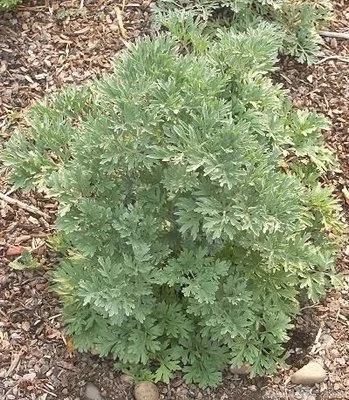
Wormwood
(Artemisia absinthium)
Plant Family:
Asteraceae
“From my garden to yours, from root to spirit, this living entity is a sacred teacher,
powerful ally, and your bridge to nature's deep wisdom."
Sunlight:
Full Sun (Thrives in bright, hot locations).
(Please slowly transition her back into full sun upon arrival)
Water:
Low. Drought-tolerant once established. Allow the soil to dry out significantly between waterings. Only water when the top 2–3 inches of soil are bone dry.
Soil:
Poor, sharp-draining, lean or sandy soil. Lean, sharp-draining, prefers poor, sandy, or gravelly soil. Rich soil makes it floppy and weak. Lean Soil
Rule:
Wormwood thrives on neglect. Giving it rich soil or too much water actually weakens its aromatic oils and rots the roots, so emphasizing "poor, sharp-draining" soil is essential for its survival.
Hardiness Perennial:
(Zones 4–9) Extremely cold-hardy; dies back completely in the winter and pushes up fresh silver foliage in spring.
Harvest:
Wait until wormwood plants are at least two years old before harvesting, as the herb's strength and potency will increase as the plant matures. Wormwood can be harvested twice a year, during late spring and full bloom. The ideal time to harvest depends on the intended use of the herb. Research has confirmed that the largest amount of bitter compounds occur around September when the plant is in full bloom, while essential oils peak in June and July. However, the leaves deteriorate in quality once they start to bloom.
GROWER'S NOTE:
This striking, silvery-grey perennial grows 2 to 3 feet tall. It practices allelopathy—its roots secrete a natural compound that suppresses the growth of neighboring plants. Give her plenty of individual space, grow in a
deep container, or plant away from delicate garden beds.
Behind the Design for Wormwood:
The Allelopathy Warning:
Just like Mugwort, Wormwood is an aggressive protector of its territory. Explicitly mentioning its chemical root-defense system tells your customers exactly why it needs a container or its own isolated corner of the garden.
Wormwood Reference & Care Sheet
Cultivation & Garden Placement Insights
The Lonely Protector: Wormwood contains absinthin, a bitter compound that washes off the leaves and secretes from the roots into the soil. This chemical defense actively stunts the growth of nearby plants (especially fennel, sage, and most vegetables). Plant it in its own container or in an isolated border where it won't choke out its neighbors.
The Sun Acclimation: Give this silver beauty a few days of dappled light before letting it bake in the full, intense high-altitude summer sun.
Pruning: Cut the plant back to the ground in late winter or early spring to keep it from getting overly woody and leggy.
From my garden to yours, from root to spirit, this living entity is a sacred teacher, powerful ally, and your bridge to nature's deep wisdom.
"The Bitter Oracle & Silver Guardian"
MAGICAL PROPERTIES
Gender: Masculine
Planet: Mars
Element: Fire
Sacred To: Artemis, Diana, Iris
Magical Associations:
Protection, amplification, psychic ability
Magical Uses:
Wormwood can be carried for protection against vengeful spirits, bewitchment, and harm in general, or hung from the rear-view mirror of your car to protect from accidents. Wormwood is burned or worn to increase psychic powers or to summon spirits. Also used as an offering to spirits and can bind them to our realm if you know what you are doing. Immerse in olive, avocado, or grapeseed oil for three full moon cycles to make a powerful anointing oil for protection and communicating with spirits.
Wormwood is a legendary plant of the crossroads—famous for its role in the classic spirit Absinthe, its connection to the book of Revelation, and its ancient reputation as a tool for seers.
The Light Side:
Vision, Banishing, & The Veil
Spirit Summoning & Prophecy:
Historically, wormwood is burned or infused to facilitate communion with spirits, aid in necromancy, and open the third eye for deep divination. It doesn't just reveal the unseen; it heightens the psychic senses to interpret messages from the other side.
Absolute Banishing:
Where mugwort creates a protective boundary, wormwood is an active exorcist. It is used to forcefully strip away heavy curses, malevolent entities, and deeply entrenched negative attachments. It cleanses by sheer psychic force.
Reclaiming Power:
Its silver color connects it to the dark moon, helping practitioners find strength in their shadows and reclaim authority over their personal space.
The Dark/Baneful Side:
Bitterness, Madness, & Neurotoxicity
The Well of Bitterness:
Named after the biblical star Wormwood that fell and turned a third of the waters bitter, its energetic shadow can infuse a practitioner's space with deep resentment, sorrow, and unyielding anger if worked carelessly. It can turn a boundary into an emotional fortress of isolation.
The Thujone Delirium:
Physically and metaphysically, wormwood contains a much higher concentration of thujone than mugwort. It is a powerful neurotoxin that can cause hallucinations, tremors, and permanent neurological damage in high doses. Because of this, it must be strictly avoided during pregnancy and approached with absolute physical caution.
The Fog of Unreality:
If used for veil work without a deeply grounded foundation, wormwood can cause psychological fragmentation—blurring the lines between genuine psychic insight and erratic paranoia or illusion.
The Lesson of the Silver Guardian: Wormwood demands a master’s hand. It stands at the edge of the wild, offering unmatched clarity and defense to those who respect its boundaries, but threatening madness and bitterness to those who treat its power lightly.
MEDICINAL PROPERTIES
Parts Used: Leaf and flowering tops
Taste: Bitter
Energetics: Cooling, warming, dry
Actions: Diaphoretic, antibacterial, antipyretic, emmenagogue, antiparasitic, anti-rheumatic, choleretic, hepatic, anthelmintic
Uses: Malaria, Cancer, Fights parasites, Chohn's, Antimicrobial, Antifungal, IBS
Constitutes & Properties:
Bitter, volatile oil, phenolic acid, flavonoids,aromatic, choleretic, mild cholagogue, antispasmodic, carminative, antipyretic, antibacterial, and antiprotozoal.
Pertinent Information: Internally can be used for loss of appetite, heartburn, minor cramps, impaired bile secretion, fevers, decreased immune response, minor fatigue, and externally for bad breath.
Caution:
This herb contains thujone, which is toxic in large doses. Limit internal use to bitters, do not take for extended periods of time. Useful as an aid in bitter form for digestive support.
Precautions: Wormwood is likely safe when taken by mouth in the amounts commonly found in food and beverages including bitters and vermouth, as long as these products are thujone-free. Wormwood that contains thujone is possibly unsafe when it is taken by mouth.
**** Always do your research and consult your physician***